Tuesday, March 26, 2013

BusinessObjects-Repository Scan and Repair

A clean system is the best starting point for your company. BusinessObjects has a repair tool for your environment. With reposcan you can check the inconsistency between your CMS database and your file system.

For example "An error occurred while searching: The property with ID SI_CUID does not exist in the object" error on search can occur due to file system and repository inconsistency.

You can find the reposcan.exe file under "<INSTALLDIR>\SAP BusinessObjects Enterprise XI 4.0\win64_x64\". Reposcan has a lot of parameters therefore i prefer to create a batch file with the parameters i needed.

Here is the repo_repair.bat file code:

reposcan.exe -dbdriver sqlserverdatabasesubsystem -connect "UID=XXX1;PWD=XXX2;DSN=XXX3;HOSTNAME=XXX4;PORT=XXX5" -dbkey XXX6 -inputfrsdir "C:\Program Files (x86)\SAP BusinessObjects\SAP BusinessObjects Enterprise XI 4.0\FileStore\Input" -outputfrsdir "C:\Program Files (x86)\SAP BusinessObjects\SAP BusinessObjects Enterprise XI 4.0\FileStore\Output"

For this example CMS repository database is SQL Server.

XXX1= Your SQL username for logging CMS repository database.
XXX2= Your password of the SQL user.
XXX3= ODBC DSN name of the CMS repository database.
XXX4= SQL Server hostname
XXX5= SQL Server portname
XXX6= Cluster key of your CMS

To find your cluster key open CCM. Right click on SIA and choose properties.

Now go to the configuration tab. At the bottom you will see your CMS Cluster Key.
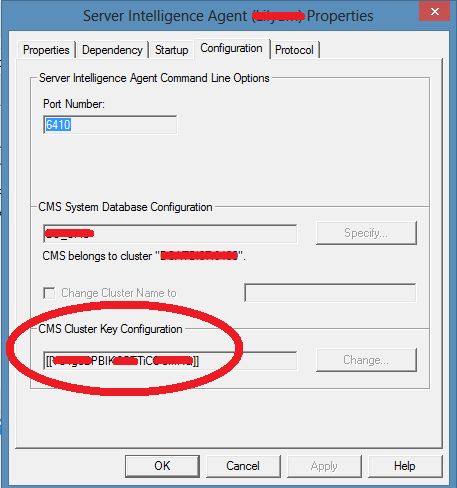
With this information your command should look like this;

reposcan.exe -dbdriver sqlserverdatabasesubsystem -connect "UID=sqluser;PWD=sqlpass;DSN=bo_cms;HOSTNAME=server_name\instance_name;PORT=1433" -dbkey [[XX1g0FVBi9VFBiCIAnAQ]]  -inputfrsdir "C:\Program Files (x86)\SAP BusinessObjects\SAP BusinessObjects Enterprise XI 4.0\FileStore\Input" -outputfrsdir "C:\Program Files (x86)\SAP BusinessObjects\SAP BusinessObjects Enterprise XI 4.0\FileStore\Output"

After you run your batch file it creates a log file under "<INSTALLDIR>\SAP BusinessObjects Enterprise XI 4.0\reposcan". Open the xml files with your browser and you fill see the results.

List of inconsistency, by type, which can be found by RDT.

Inconsistencies between the CMS and the FRS:
  • The object exists in the CMS database, but there is no corresponding file in the FRS.
  • The file exists in the FRS, but there is no corresponding file in the CMS database.
  • The size of the file does not match the InfoObject file size.
  • The FRS folder is empty.

Inconsistencies in the CMS metadata:
  • The object has a missing or invalid Parent Object ID.
  • The object has a missing or invalid Owner Object ID.
  • The object has a missing or invalid Submitter Object ID.
  • The object's last successful instance is missing or invalid.
  • The object references a calendar that doesn't exist.
  • The preferred server does not exist.
  • The event or events that this object is waiting on does not exist.
  • This object triggers an event that does not exist.
  • Orphaned Access Control entry.
  • The preferred server does not exist.
  • A specific user account has multiple favorites folders.

More information : http://wiki.sdn.sap.com/wiki/display/BOBJ/How+to+use+Repository+Diagnostic+Tool

For other databases and reposcan parameters refer to xi4_bip_repository_diagnostic_tool_en.pdf on SAP market.

Thursday, February 21, 2013

BusinessObjects-Infoview freezes when click on "Document List"

You can find several solutions for this dummy situation. I never tried it but IE8 users solve this by setting their zoom ratio to %100 on their browser.

But i faced this problem on IE9 and the zoom trick didn't help me. I solved it by adding "about:blank" to the trusted sites on IE. Hope this helps you too.

BusinessObjects-Merged Dimension Incompatible Object

Merging dimension is always a need by creating webi documents. But by default you can use only dimensions from one query, merged dimensions and the measures. If you want to use dimensions from other query and you can't merge them, you got an error message "Cannot drop here - the object is incompatible". See pic below.


To avoid this problem you have to create a detail variable object and associated it to the merged dimension. In the example above you want to use the phone numbers from Query2. Select the type as "detail" and associated object.


Now you can use this variable with your Query1 dimensions.


To understand why this works with detail please refer to this document:
http://michaelwelter.wordpress.com/2011/04/18/tips-for-merging-dimensions/

BuisnessObjects-Order Prompts in Web Intelligence

If you use prompts which you have defined in your universe, you can't order them through Query panel in your web intelligence document.

To order your prompts you have to use the {user:n} parameter in your filter definition. n is the order number of the prompt and starts from 0.

Here is an example:

On the query panel you see that the order of the prompts is ProductNumber, ProductName, ProductId.

After running the query you will see that the prompt order is like ProductId, ProductName, ProductNumber.

Take a look to the SQL script and you can see the definition of the prompts. They are like;

   ( SalesLT.Product.ProductNumber  IN  @Prompt('Enter values for Productnumber:','A','Productheader\Productnumber',Multi,Free,Persistent,,User:2)  )
   AND
   ( SalesLT.Product.Name  IN  @Prompt('Enter values for Product Name:','A','Productheader\Product Name',Multi,Free,Persistent,,User:1)  )
   AND
   ( SalesLT.Product.ProductID  IN  @Prompt('Enter values for Productid:','N','Productheader\Productid',Multi,Free,Persistent,,User:0)  )

So, all you have to do is change the numbers of the end of your prompts.

Tip: If you parse your filter in universe you will get an error message like this:


 Just ignore it.


Tuesday, November 27, 2012

BusinessObjects-How to find which report is running from database session

Sometimes you see very large SQL expressions which are killing your database systems. With audit reports you can find which reports have run after they finished. But with this little code you can directly find the user, the report and the universe from your database directly on demand.

http://www.dallasmarks.org/blog/2011/10/tips-and-tricks-identifying-business-objects-queries-using-end_sql/

Just put this lines to your universe parameters "END_SQL" line:
/* @Variable('UNVNAME') - @Variable('BOUSER') - @Variable('DOCNAME') */

Thats it. Your query will look like this:


Your dba will appreciate you.

BusinessObjects-How to use Oracle hints in Universe

If you use an Oracle connection in your universe and put the tables from the table browser, you can't use hints with your table. You can use derived tables for use of Oracle hints.

But there is another way put hints to your queries. Just go to your universe. Create an object with your rule. For example:


There is a "1" at the end. Because BO puts a comma sign after each object by generating the sql. Therefore we put a dummy value.

Ok. Lets get a look after we export our universe and use the hint object. (Don't forget to use this object as the FIRST object in Webi)


Friday, June 15, 2012

BusinessObjects-XI 3.1 and Internet Explorer 9

Business Objects XI 3.1 does not support Internet Explorer 9. But there is a very simple workaround.

Go to the folder:
XXXX\Business Objects\Tomcat55\webapps\InfoViewAppActions

Create a page named httperror_400.htm and put the following code in it:

"
<html>

<head>
<meta http-equiv=Content-Type content="text/html; charset=utf-8">
<title>Missing Page</title>
</head>

<script type="text/javascript">
function fixUrl(strToReplace){
urlStr = window.document.location.toString();
return urlStr.replace(strToReplace,"");
}
// Comment out the following line with the double slash (//) to debug
window.location=fixUrl("/InfoViewAppActions");
</script>


<body>
<script type="text/javascript">


urlStr = window.document.location.toString();
urlStrNew = fixUrl("/InfoViewAppActions");

document.writeln("Before:<br/>");
document.writeln(urlStr);
document.writeln("<p>");
document.writeln("After:<br/>");
document.write("<a href='" + urlStrNew + "'>");
document.write(urlStrNew);
document.writeln("</a>");

</script>
</body>
</html>
"

Save and close your document. Now go to the folder:
XXXX\Business Objects\Tomcat55\webapps\InfoViewAppActions\WEB-INF\

Open the web.xml file. Search for where error-code 404 is catched and add the following code:


<error-page>
<error-code>400</error-code>
<location>/httperror_400.htm</location>
</error-page>

more information can be found at:
http://www.forumtopics.com/busobj/viewtopic.php?t=170250&amp;postdays=0&amp;postorder=asc&amp;start=43